The Distributor's Guide to Badge and Credential Timelines
Your client calls on Monday. The event is Friday. They need 200 custom lanyards with printed badges, and they’re asking if you can make it happen.
You want to say yes. But you also know that promising the impossible sets everyone up for disappointment, rush fees and damaged relationships.
The truth is, most credential projects don’t fail because of supplier problems. They stall because no one mapped out the timeline upfront, or because a distributor underestimated how long a seemingly small step would take.
This guide walks through the real timeline for custom lanyards, retractable badge reels, badge holders, badges and name tags, cards and credentials, and radio frequency identification (RFID) cards and fobs. You’ll see where delays hide, what “rush” actually means, and how to set expectations that keep projects moving.
Why Timelines Matter (and Why They Break Down)
When a project runs late, it’s rarely one big failure. It’s a series of small delays that compound:
-
Artwork takes three days longer than expected because the client keeps tweaking colors.
-
Proof approval sits in someone’s inbox for 48 hours.
-
A supplier finds out mid-production that the attachment style wasn’t specified.
-
Rush fees get added because no one accounted for weekend or holiday closures.
Each delay is fixable on its own. Together, they turn a comfortable two-week timeline into a nail-biter. The fix isn’t working faster; it’s knowing where time goes and planning around it.
The Real Timeline: Where Each Step Lives
Here’s what a typical custom credential project looks like from inquiry to delivery, broken into the stages that matter.
Step 1: Specification and Quoting (1 to 2 days).
This is where you gather details and get pricing. For straightforward orders with clear specs (product type, quantity, artwork ready, standard options), quotes move quickly. If the client is still deciding between vinyl and rigid badge holders, or if they want to see multiple colorway options for lanyards, add time.
What slows it down: Unclear quantities, missing artwork, requests for samples before committing, or questions that require back-and-forth with your supplier.
What speeds it up: Having a simple spec sheet ready (product type, quantity, material preferences, attachment style and whether artwork is print-ready), supplying templates and providing other guidelines (artwork and database guidelines)
Step 2: Artwork Review and Approval (1-3 days, sometimes longer)
This is the single biggest variable in most projects. If your client submits vector artwork with correct dimensions and Pantone colors, and they approve the proof in 24 hours, you’re golden. If they submit a low-resolution JPEG that needs to be recreated, or if approvals need to route through three people, plan for delays.
What slows it down: Non-vector files, unclear branding guidelines, multiple rounds of edits, delayed responses to proof requests, or trying to match a physical sample without a clear color reference.
What speeds it up: Keeping approved artwork and color notes on file for repeat clients, confirming who has final approval authority before you start, and limiting revision rounds upfront.
Step 3: Production (3–10 business days, depending on the product and method)
Production timelines vary by category:
-
Custom lanyards: Standard screen-printed or dye-sublimated lanyards typically take 5–7 business days once art is approved. Complex designs or specialty attachments may add a day or two.
-
Retractable badge reels: If you’re ordering stock reels with a simple imprint, expect 3–5 days. Custom colors or non-standard clips extend that window.
-
Badge holders: Vinyl and rigid holders with no customization ship quickly. If you’re adding custom printing or special features, plan for 5–7 days.
-
Badges and name tags: Digital printing on PermaBadges or similar products usually takes 3–5 days. Dye-sublimation or foil overlays take longer.
-
Cards and credentials / RFID cards and fobs: Plain cards move fast. Encoding, programming or syncing RFID chips to specific systems adds 2–4 days and sometimes requires testing.
What slows it down: Dye-sublimation, specialty finishes, RFID programming and validation, large quantities that require batching, or orders placed during peak seasons (back-to-school, conference season, year-end events).
What speeds it up: Choosing standard options, confirming minimum order quantities (MOQ) upfront so there are no surprises and placing orders well ahead of known busy windows.
Step 4: Quality Control and Packing (1–2 days)
Good suppliers check for defects, verify quantities and pack orders carefully. This step is easy to forget when you're calculating timelines, but it’s always there.
What slows it down: Large orders that require individual inspection, orders going to multiple ship-to addresses, or special packaging requests.
What speeds it up: Clear shipping instructions submitted upfront, and choosing suppliers with efficient fulfillment workflows.
Step 5: Shipping and Delivery (2–7 days, depending on distance and method)
Ground shipping within the continental U.S. typically takes 3–5 business days. Expedited options are available, but they cost more and still require the previous steps to finish first.
What slows it down: Remote locations, choosing the cheapest shipping option or underestimating transit time to your client’s actual event location (not just their office).
What speeds it up: Paying for expedited shipping, confirming the delivery address early and knowing whether your supplier offers drop-ship services directly to the event venue.
What “Rush” Really Means (and What It Costs)
Rush service isn’t magic. It means your supplier moves your project to the front of the production queue, sometimes works evenings or weekends, and uses faster shipping. It does not mean skipping artwork approval, ignoring proof rounds or shipping before quality checks.
Here’s what rush can realistically deliver:
-
Tight but doable: A 10-day project compressed into 7 days if artwork is ready, approvals are fast and you’re willing to pay for expedited production and shipping.
-
Possible but expensive: A 10-day project squeezed into 3-5 days with premium rush fees and overnight shipping.
-
Not happening: A 10-day project delivered in 24 hours when artwork hasn’t been submitted yet.
Rush fees typically add 20%–50% to the base cost, and expedited shipping compounds that. The better move is planning far enough ahead that rush isn’t necessary.
Where Projects Actually Stall (and How to Prevent It)
Most timeline problems fall into a few predictable patterns:
Stall Point 1: Artwork Limbo
The client says artwork is ready. You submit it for proof. The supplier comes back with questions about resolution, color matching or bleed areas. Two days are gone before you even start.
The fix: Ask for vector files upfront. Confirm color specs in Pantone or CMYK values. Keep a checklist of what “print-ready” means and share it with clients before they submit.
Stall Point 2: Approval Delays
The proof gets sent to the client. It sits in an inbox. Or it gets forwarded to someone else who’s traveling. Or it comes back with changes that require a second proof, which also sits.
The fix: Confirm approval timelines before the project starts. Get a single point of contact who can make final decisions. Set a clear window for feedback (24–48 hours) and explain what happens if approvals don’t come through on time.
Stall Point 3: Underestimating RFID Complexity
RFID projects require more than just picking a chip. You need to know the system it’s syncing with, the read range required and whether encoding or programming is needed. If those questions aren't answered upfront, production stops.
The fix: Confirm system compatibility with your supplier before quoting. Ask the client for their access control or tracking system details early. Build extra time into RFID timelines until you’re confident the specs are locked.
Stall Point 4: Seasonal Surges No One Planned For
August and September are slammed because of back-to-school orders. January is busy with new-hire onboarding and year-start events. Conference season creates spikes in spring and fall. If you submit an order during these windows without accounting for longer lead times, you’re competing with everyone else.
The fix: Track your client’s event calendars. Reach out proactively before busy seasons and suggest ordering early. Keep a small buffer stock for repeat clients who order predictably.
A Practical Timeline You Can Share with Clients
Here's a simple framework you can adapt:
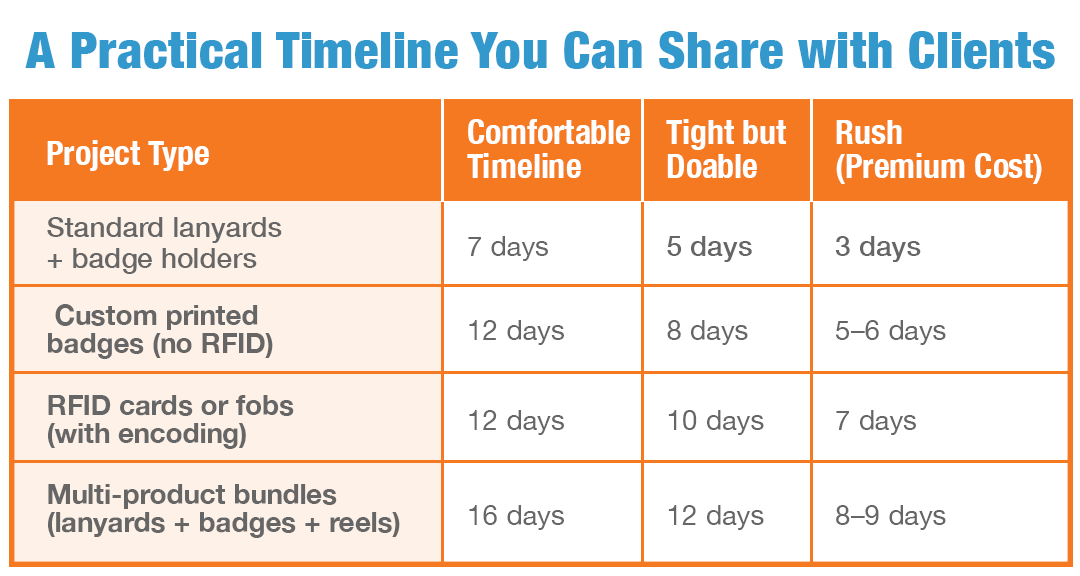
These timelines assume print-ready artwork, fast approvals and standard options. Add 2–4 days for complex artwork, specialty finishes or multilocation shipping.
Small Moves That Keep Timelines on Track
You don’t need a project management degree to run credential projects smoothly. A few simple habits make a big difference:
-
Keep a timeline template. Map out the five steps for every project type you quote regularly. Adjust based on the specifics, but start with a baseline.
-
Confirm artwork requirements early. Share a quick checklist of what print-ready means (vector format, correct dimensions, color specs). Catching issues before submission saves days.
-
Set approval windows. Let clients know upfront that proof approval has a 24–48 hour window, and delays in that window push the delivery date.
-
Plan around peak seasons. If you know a client needs credentials in September, start the conversation in August (or earlier).
-
Build in a buffer. If your supplier quotes 7 days, tell your client 9. The extra cushion protects you from minor delays and makes you look reliable when you deliver early.
Keep It Predictable
Timeline problems are rarely about bad luck. They’re about missing information, unclear expectations or underestimating how long a step actually takes. The fix is simple: Map the process, communicate the steps and build in realistic buffers. When you do, rush orders become rare exceptions instead of weekly fire drills.